What an Acre of Land Costs in Clinton, Greene and Highland Counties: Farmland vs. Homesite Pricing
An acre of rural land in the Glasshouse Realty service area can cost anywhere from about $7,000 to more than $30,000, and the single biggest factor is how the parcel will be used. Tillable farmland in Clinton County averages roughly $7,700 an acre, while the median asking price across all Clinton County land listings runs about $33,000 an acre. The gap is the same story in Greene County and Highland County: productive cropland is valued on what it grows, and a small rural homesite is valued on where it sits. Here is what an acre actually costs across the three counties, what drives the number, and how to budget for land.
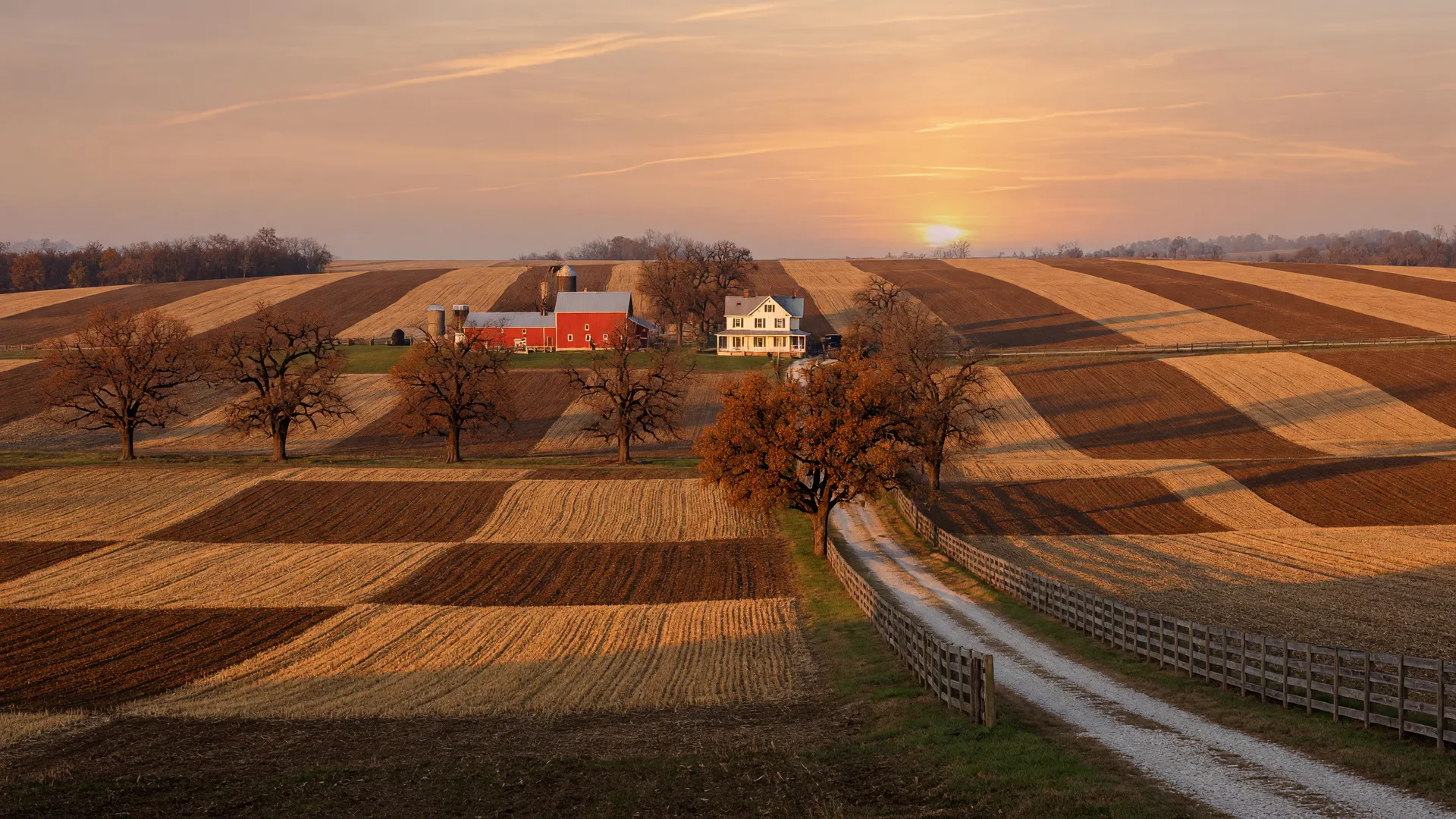
The same Ohio acre can be worth about $8,000 as tillable farmland or more than $30,000 as a rural homesite.
How do land prices compare across the three counties?
Buyers searching for acreage across Clinton County, Greene County, and Highland County usually start with one question: what does an acre cost? The honest answer is that there is no single number, because an acre of tillable farmland and an acre of rural homesite are priced on completely different logic. The table below separates the two so the comparison is apples to apples.
Farmland averages reflect agricultural income value reported by AcreValue. Small-parcel averages reflect residential demand for 0 to 2 acre homesites reported by Prime Land Buyers. The Land.com figure is the median asking price across all Clinton County land listings, which skew toward larger farmland parcels.
Table 1. Land value indicators for Clinton, Greene, and Highland counties, Ohio, from AcreValue, Land.com, and Prime Land Buyers (2025-2026).
| County (county seat) | Farmland average per acre | Small parcel (0-2 ac) average | What moves the number |
|---|---|---|---|
| Clinton (Wilmington) | ~$7,700 (AcreValue) | Median asking across all listings ~$33,000 (Land.com) | Larger tillable parcels listed ~$25,000-$29,500/ac; farmland valued on crop income |
| Greene (Xenia) | No published county average | ~$99,700 (Prime Land Buyers) | Small parcels priced by residential and development demand near the Dayton metro |
| Highland (Hillsboro) | No published county average | ~$57,600 (Prime Land Buyers) | Small parcels priced by residential demand, well below Greene's metro-adjacent level |
The spread is the story. The same acre of ground can be worth about $7,700 as tillable farmland in Clinton County or more than $99,000 as a small homesite in Greene County, and neither number is wrong. One reflects what the land grows; the other reflects the value of a buildable lot near a metro. For buyers, the practical takeaway is to compare parcels of similar size and use, never a raw price per acre across different kinds of ground.
For context on what the same budget buys in built homes, our $250,000 price comparison covers Wilmington, Blanchester, and Sabina, and the Country & Acreage neighborhood page shows where acreage listings actually sit.
What do the farmland benchmarks say?
For tillable ground, the most reliable numbers come from the USDA National Agricultural Statistics Service and the Ohio State University Extension. These are statewide and regional benchmarks, and they anchor the county figures. Southwest Ohio, which includes all three counties, carries some of the highest cropland values in the state.
Table 2. Ohio farmland value benchmarks from the USDA National Agricultural Statistics Service and the Ohio State University Extension Western Ohio Cropland Values and Cash Rents survey (2024-2026).
| Benchmark | 2024 | 2025 | 2026 | Source |
|---|---|---|---|---|
| Ohio farm real estate average | - | ~$9,350/ac | ~$9,650/ac | USDA NASS |
| Ohio cropland average | - | ~$9,750/ac | ~$10,100/ac | USDA NASS |
| Western Ohio average producing cropland | ~$11,604/ac | ~$11,856/ac (projected) | - | OSU Extension |
| Western Ohio top cropland | ~$13,935/ac | ~$14,384/ac (projected) | - | OSU Extension |
In plain terms, good tillable ground in this corner of Ohio trades in the roughly $11,000 to $14,000 an acre range at the regional benchmark level, while Clinton County's countywide farmland average sits a bit lower at about $7,700 an acre because it blends in lower-productivity and non-tillable acres. For the full picture on what a home with acreage costs, our parks, lakes, and acreage guide and the Market Report round out the numbers.
Why can the same acre be worth $8,000 or $33,000?
The gap comes down to what the buyer is actually paying for. Tillable farmland is valued on its income: what the soil can grow and what that crop is worth. A small rural homesite is valued on its location: how close it is to jobs, schools, and services, and whether it is ready to build on. The two are different markets, and the price per acre reflects whichever one applies.
That is why Greene County's small-parcel average is so much higher than Clinton County's farmland average. Greene sits against the Dayton metro, where a buildable acre carries development value. Clinton County is more rural, so its small parcels carry less of that premium and its farmland carries more weight in the countywide picture. None of this is a judgment about any community; it is simply how the two markets price ground.
For buyers weighing a commute against land value, the commute guide and the Greene County and Clinton County pages put the tradeoff in context.
What drives the price per acre?
Once you know whether a parcel is farmland or a homesite, five factors set the actual number. The table below summarizes how each one moves value.
Table 3. The factors that move the price per acre on rural land in southwest Ohio, per OSU Extension and land-valuation sources.
| Factor | Typical effect on value |
|---|---|
| Soil productivity | Dominant for tillable ground; southwest Ohio top cropland yields about 229 bu corn/ac versus about 157 bu on bottom land, and value tracks yield |
| Road frontage and access | Direct public-road frontage commands the highest value; landlocked or deeded-access tracts sell at a discount |
| Utilities at the line | Power, water, and sewer or septic-ready service add value; parcels that need a new well or septic are discounted |
| Wooded vs. tillable | Tillable cropland commands the premium; recreational wooded land in southern Ohio runs roughly $2,500-$6,000/ac |
| Parcel size | Price per acre falls as parcel grows; a 20-acre parcel often costs 50-80% less per acre than a 1-acre lot |
Steep, wet, or irregular ground and landlocked parcels sell at a discount, while flat, buildable, frontage-rich acres with productive soil command the top of the range. Our well and septic guide covers the utility side of that math, and the new construction and building lots guide shows how the same factors play out for buyers who want to build.
How many acres do acreage buyers actually need?
The size of the parcel shapes both the price per acre and the lifestyle. Rural homesites in southwest Ohio typically sit on 1 to 5 acres, hobby farms and homesteads usually need 5 to 10 acres, and buyers who want woods, trails, or real privacy typically look at 20 acres or more. County zoning minimums vary, and the common rural minimum is around 1 acre.
Because price per acre falls as size grows, a 5 acre homesite will cost more per acre than a 40 acre tract, but the 40 acre tract costs far more in total. The right size depends on what you plan to do with the land, which is exactly the kind of conversation we have with buyers every week. The Country & Acreage page walks through the options on the ground.
What surprises buyers most when they price land?
In our experience helping buyers and sellers of rural acreage in Clinton County, the single most common surprise is the gap between what a parcel is listed for and what it appraises for as farmland. A seller may price a large tract by the acre based on a nearby small-parcel sale, and a buyer may assume the per-acre price holds at any size. It does not, and the difference is often tens of thousands of dollars.
Here is how we plan for it on every land deal. We pull the county auditor's record for assessed value and current taxes, we review recent sold comps for parcels of similar size and use rather than a raw price per acre, and we confirm road frontage, legal access, utilities at the line, and well and septic feasibility before any offer. That last step matters most: a parcel priced like it is ready to build can carry thousands in added cost if it needs a new well or septic system.
This is general education, not legal, tax, or financial advice. For the specifics of any land purchase, work with a qualified attorney, a title company, and a lender who handle rural transactions, and check zoning with the county before you commit.
What should buyers and sellers do with these numbers?
Land is priced differently from homes, and the checklist below is the one we run on every acreage transaction. You can run it yourself.
1. Compare parcels of similar size and use
Never compare a raw price per acre across a 1 acre homesite and a 40 acre field. Pull sold comps for parcels of similar acreage, soil, and access.
2. Look up the parcel in the county auditor's records
The Clinton County Auditor, the Greene County Auditor, and the Highland County Auditor each publish free property searches with assessed value and current taxes.
3. Confirm access and utilities before you offer
Verify public-road frontage or a legal easement, and find out what utilities are at the property line. A parcel that needs a new well or septic can add thousands to the true cost.
4. Check zoning and soil
Confirm the parcel can be used the way you intend, whether that is a homesite, a hobby farm, or tillable ground. County zoning and soil data are public records.
5. Work with the right professionals
Land transactions involve survey, title, zoning, and financing that differ from a standard home sale. A qualified attorney, title company, and lender who handle rural deals are worth the cost.
For the rest of the ownership picture, our property tax guide shows what a rural home's bill looks like, and the Selling Guide covers how we price land against recent comps when it is time to sell.
Land pricing questions buyers ask us most
How much is an acre of farmland in Clinton County, Ohio?
AcreValue estimates Clinton County farmland at about $7,700 an acre, while larger tillable parcels listed on Land.com run roughly $25,000 to $29,500 an acre. The Ohio State University Extension Western Ohio survey puts average producing cropland near $11,600 to $11,900 an acre. The number depends on soil quality, size, and location.
Why does land cost more in Greene County than in Clinton County?
The two numbers measure different things. Greene County's small-parcel average of about $99,700 an acre reflects residential and development demand near the Dayton metro, not farmland income. Clinton County's farmland average of about $7,700 an acre reflects what the land grows. A small homesite near a metro and a large tillable field are priced on entirely different logic.
What is the least expensive type of rural land to buy?
Wooded recreational land in southern Ohio typically trades in the roughly $2,500 to $6,000 an acre range, while tillable cropland commands a premium because it produces income. Steep, wet, irregular, or landlocked acres also sell at a discount, and larger tracts usually cost less per acre than small ones.
Does the price per acre drop as I buy more land?
Yes. Per-acre pricing falls sharply as parcel size grows. A 20 acre parcel often costs 50% to 80% less per acre than a 1 acre lot, because small parcels carry residential or development value while larger tracts are valued on agricultural income.
What should I check before making an offer on land?
Check the county auditor's records for assessed value and current taxes, review recent sold comps for similar parcels, confirm road frontage and legal access, find out what utilities are at the property line, and verify well and septic feasibility and zoning before you commit. Work with a qualified attorney, title company, and lender on the legal and financing side.
Where can I look up land values for a specific parcel?
Use the Clinton County Auditor, the Greene County Auditor, and the Highland County Auditor for assessed value and taxes on a specific parcel. AcreValue publishes estimated farmland values mapped by county, and the USDA National Agricultural Statistics Service reports statewide benchmarks.
Sources and notes
Farmland and land-value figures reflect public data reported in 2025 and 2026 by the sources below. County farmland averages are estimates and can differ from a specific parcel, which is why the county auditor's record and recent sold comps matter on any individual property.
- Mossy Oak Properties, Ohio land prices per acre (USDA NASS 2025-2026 figures)
- OSU Extension, Western Ohio Cropland Values and Cash Rents 2024-25 survey
- AcreValue, Ohio farmland values (Clinton County average)
- Land.com, Clinton County land market insights
- Prime Land Buyers, how much is an acre of land in Ohio (2025 county data)
- High Point Land Company, factors affecting land value
Looking for land or a home with acreage?
Our team works in downtown Wilmington and knows which parcels have utilities, which are priced by the acre, and which are worth a second look. Reach out any time.
Contact Glasshouse Realty