Living in Wilmington Ohio, Working in Dayton, Cincinnati & Columbus: A Commuter's Guide
One of the most common questions we hear from out-of-town buyers is simple: "How far is it really?" Here is an honest breakdown of what it actually takes to live in Clinton County and work in Ohio's major job centers.
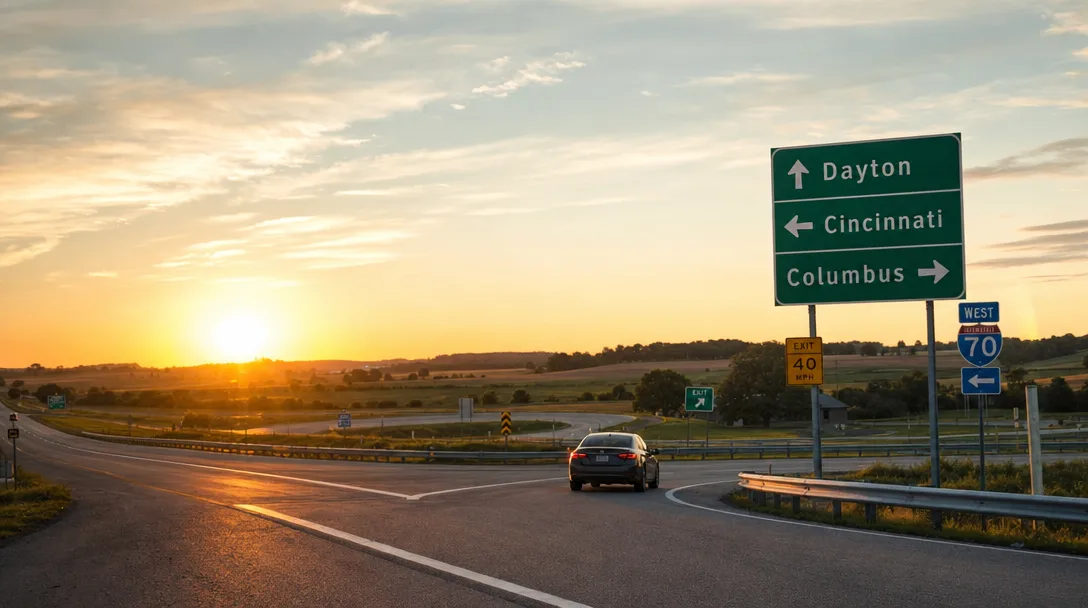
Wilmington, Ohio sits at a strategic intersection. Literally. The junction of I-71 and U.S. Route 68 places this Clinton County town within easy reach of three of Ohio's largest metro areas, and the question we hear most often from buyers considering a move is about the commute: "Can I really live here and work in Cincinnati?" or "What is the drive to Dayton like?"
The short answer: yes, thousands of people do it every day. Wilmington's location offers a balance that is surprisingly rare in Ohio -- affordable small-town living with big-city job access. But "doable" and "pleasant" are two different things, and the right answer depends on your schedule, your tolerance for windshield time, and how many days a week you need to make the trip.
As a local real estate team that helps buyers from all over the region find homes in Clinton County, we have learned exactly which commutes work and which ones wear on people. This guide lays out the real numbers, the best routes, and what you need to know before making the decision.
Where Wilmington sits on the map
Wilmington is located in the heart of Clinton County, approximately 40 miles northeast of Cincinnati and 30 miles southeast of Dayton. The town's position near the intersection of I-71 and U.S. 68 -- two major north-south and east-west corridors -- gives it what transportation planners call excellent regional connectivity. In plain terms: getting on the highway is fast, and once you are on it, the drive is mostly straight and uncongested compared to suburban beltway traffic.
The terrain itself helps. Unlike the stop-and-go of a metro-area interstate, the ride from Wilmington to any of these cities moves through open farmland and rolling hills. It is the kind of drive where you can set the cruise control and let the miles roll by. For many commuters, that makes a significant difference in how the trip feels.
One other factor worth noting: fuel prices in the Wilmington area and along the I-71 corridor tend to be lower than in Ohio's major metros, so the operational cost of a longer commute is somewhat offset by cheaper fuel. It is a small detail, but it adds up over the course of a year.
Wilmington's location at a glance
3
Major metro areas within an hour drive
I-71
Main north-south corridor connecting all three cities
2
Major interstates: I-71 and US 68
Commute Breakdown
Wilmington to each major city
The times below are realistic estimates for a typical weekday commute under normal traffic conditions. Morning and evening rush hours will add a few minutes, particularly on the approach to downtown Cincinnati or downtown Columbus. Weekends or off-peak travel can shave five to ten minutes off each direction.
Cincinnati
The most popular commute route from Wilmington. Head south on I-71 and you will reach the northern Cincinnati suburbs like Mason and West Chester in about 25-30 minutes. Downtown Cincinnati takes closer to 45 minutes, and the airport (CVG) is about 50 minutes. This is the route that makes the most sense for a hybrid work schedule -- two or three days in the office, the rest working from home in Wilmington.
Best route
I-71 South. Exit at Pfeiffer Road (Mason) or continue to downtown via I-71 / Fort Washington Way.
Dayton
The shortest of the three major commutes. Take I-71 North to I-675 North, and you will reach southern Dayton suburbs like Beavercreek and Centerville in under 30 minutes. Downtown Dayton lands around 35-40 minutes. Wright-Patterson Air Force Base -- one of Ohio's largest employers -- is about 40 minutes door-to-door. For commuters heading to Wright-Patt or the growing tech corridor along I-675, Wilmington is one of the most affordable bedroom communities available.
Best route
I-71 North to I-675 North. Exit at Colonel Glenn Highway (Wright-Patt) or continue on I-75 into downtown Dayton.
Columbus
The longest commute of the three, but still within the range of what many Ohioans consider a reasonable drive. I-71 North from Wilmington runs straight into the southern Columbus suburbs like Grove City and the Hilltop area in about 45-50 minutes. Downtown Columbus and the Short North are roughly an hour. For someone who commutes two days a week, the trade-off -- an extra 20 minutes each way in exchange for significantly lower housing costs -- pencils out favorably for many buyers.
Best route
I-71 North. Exit at Grove City / Stringtown Road for southern suburbs, or continue to I-70 / downtown Columbus.
Quick commute reference
| Destination | Approx. Time | Approx. Miles | Primary Route |
|---|---|---|---|
| Mason / Kings Island | 25-30 min | ~25 mi | I-71 S |
| Dayton (downtown) | 35-40 min | ~40 mi | I-71 N / I-675 N |
| Beavercreek / Centerville | 28-35 min | ~35 mi | I-71 N / I-675 S |
| Wright-Patterson AFB | 38-45 min | ~42 mi | I-71 N / I-675 N |
| Cincinnati (downtown) | 40-50 min | ~45 mi | I-71 S |
| CVG Airport | 45-55 min | ~50 mi | I-71 S / I-275 W |
| Columbus (downtown) | 55-65 min | ~60 mi | I-71 N |
The hybrid work advantage: why Wilmington works for flexible schedules
The single biggest factor driving relocation to Wilmington is the rise of hybrid and remote work. When you only need to be in the office two or three days a week, the calculus of a longer commute changes entirely. A 45-minute drive three times a week feels manageable. A 45-minute drive five times a week starts to wear on most people.
Wilmington has become especially popular with employees of companies based in the Cincinnati and Dayton metros who now operate on hybrid schedules. The town's investment in fiber internet infrastructure means working from home in Clinton County is not a compromise -- you get reliable, high-speed connectivity that supports video conferencing, large file transfers, and multiple devices without issues.
For a two-day-a-week hybrid commuter heading to Cincinnati or Dayton, the monthly fuel cost difference between living in the suburbs and living in Wilmington is roughly $60 to $100. When you compare that to the difference in home prices -- where the same house might cost 30 to 50 percent less in Wilmington -- the financial picture becomes very clear, very quickly.
The median home price in Wilmington sits well below that of Cincinnati, Dayton, and Columbus suburbs. For a more detailed breakdown of what your money buys, our Cost of Living page compares housing, utilities, transportation, and everyday expenses across the region.
What commuters wish they knew before buying
Over the years, we have helped dozens of buyers who made the move to Wilmington while keeping jobs in the surrounding cities. Here is what they tell us they wish they had known upfront:
Traffic flows opposite the metro rush
This is the hidden advantage of commuting from Wilmington. Because you are driving away from the city center in the morning and toward it in the evening, your commute is often lighter than the reverse trip. A Cincinnati-to-Mason driver sits in bumper-to-bumper traffic heading north. A Wilmington-to-Cincinnati driver faces open highway heading south.
Winter weather is real, but manageable
Ohio winters bring snow and ice, and I-71 can get slick. The good news: ODOT is generally quick with plows and salt on this interstate corridor. Most commuters tell us they add 10 to 15 minutes on snowy mornings and plan to leave early on the handful of heavier weather days. It is rarely a dealbreaker, but it is worth planning for.
Fuel savings partially offset the miles
Gas prices in Wilmington and along the I-71 corridor consistently run below metro-area prices. For a commuter driving 80 to 100 round-trip miles three days a week, that saving of 15 to 25 cents per gallon adds up to roughly $30 to $50 a month. It is not a game-changer, but it does narrow the gap between living close to work and living affordably.
Proximity to I-71 is a home-buying factor
Homes on Wilmington's south and east sides offer the fastest access to I-71. Buyers who prioritize a quick commute should focus on neighborhoods within 10 minutes of the on-ramp. Our Neighborhood Guides break down which areas provide the best highway access and which offer a quieter, deeper-country feel.
The "weekend factor" makes up for weekday travel
This is the part buyers do not always anticipate. When your daily life includes a walkable downtown, neighborhood parks, Cowan Lake 10 minutes away, and community events at the Murphy Theatre, the weekday commute feels different than it does when you just pass through a suburban subdivision on the way home. The lifestyle quality after you park the car is what makes the trade-off worth it.
What the commute means for your home search
The most common commute-related decision buyers face is a trade-off: square footage and land versus proximity to the interstate. A home on the edge of town with five acres and a long driveway will cost less per square foot than a newer subdivision home closer to the highway, but it adds 10 to 15 minutes to every trip.
For buyers who commute three or more days a week, the right move is usually to prioritize proximity to I-71. The minutes saved each morning compound quickly. For buyers who commute twice a week or less, the extra drive time to a rural property is an easy trade for the privacy, space, and views that acreage provides. For more on the range of options, see our guide to homes with acreage in Clinton County.
The current market in Wilmington offers options across the price spectrum. Following the latest trends, the median home price in the area ranges from approximately $230,000 to $280,000, depending on location, size, and condition. Our most recent market report covers the latest numbers in detail.
For first-time buyers in particular, the commute equation can make the difference between owning a home and renting indefinitely. The First-Time Buyer Academy covers financing, down payment assistance, and the full purchase process step by step.
The bottom line on Wilmington's location
Wilmington is not for everyone. If you need to be in a downtown Cincinnati office five days a week, the 45-minute drive each way will eventually feel long. But if you work a hybrid schedule, if your job is in Dayton's growing tech corridor, if you are retired or semi-retired and want access to city amenities without paying city prices, or if you simply value the idea of coming home to a quiet, connected community after a day in the city -- Wilmington's location starts to look like one of the best strategic moves you can make.
The town itself has everything a commuter needs: reliable internet, a walkable downtown for evenings and weekends, grocery and retail options close to home, and a quality of life that does not require you to get in the car for every single errand. Our complete guide to living in Wilmington covers the full picture if you are still weighing the decision.
And if you are ready to start looking at specific homes and neighborhoods, we know exactly which areas match your commute priorities. No pressure, no pitch -- just a team that lives here and wants to help you find the right fit.
Thinking about making Wilmington your home base?
The Glasshouse Realty Wilmington team knows every neighborhood, every commute route, and every corner of Clinton County. We will help you find a home that matches your commute needs, your budget, and the lifestyle you are looking for. Stop by our downtown office or give us a call to get started.
Or visit us at 117 N. South St, Suite A, Wilmington, OH 45177.